Signs Your Drain Field Is Failing — and What to Do About It
A failing drain field is one of the more serious septic problems a homeowner can face — but the signs often show up early, long before it becomes a crisis. Knowing what to look for gives you a real chance to address the problem before it becomes a full replacement.
What the Drain Field Actually Does
The drain field — also called the leach field — is where treated liquid effluent from your septic tank disperses into the soil. A network of perforated pipes runs through gravel-filled trenches, allowing effluent to seep out gradually and filter through the ground before rejoining the water table. The soil does the final stage of treatment, removing bacteria, nutrients, and contaminants as the water passes through it.
When the drain field fails, that absorption process breaks down. Effluent has nowhere to go. It backs up into the tank, surfaces above ground, or both. The result is a septic system that can no longer handle normal household use — and a problem that only gets worse the longer it goes unaddressed.
The good news is that drain field failure rarely happens without warning. The signs tend to appear gradually, and the earlier you catch them, the more options you have for remediation or repair rather than full replacement.
Warning Sign 1: Wet or Soggy Ground Above the Drain Field
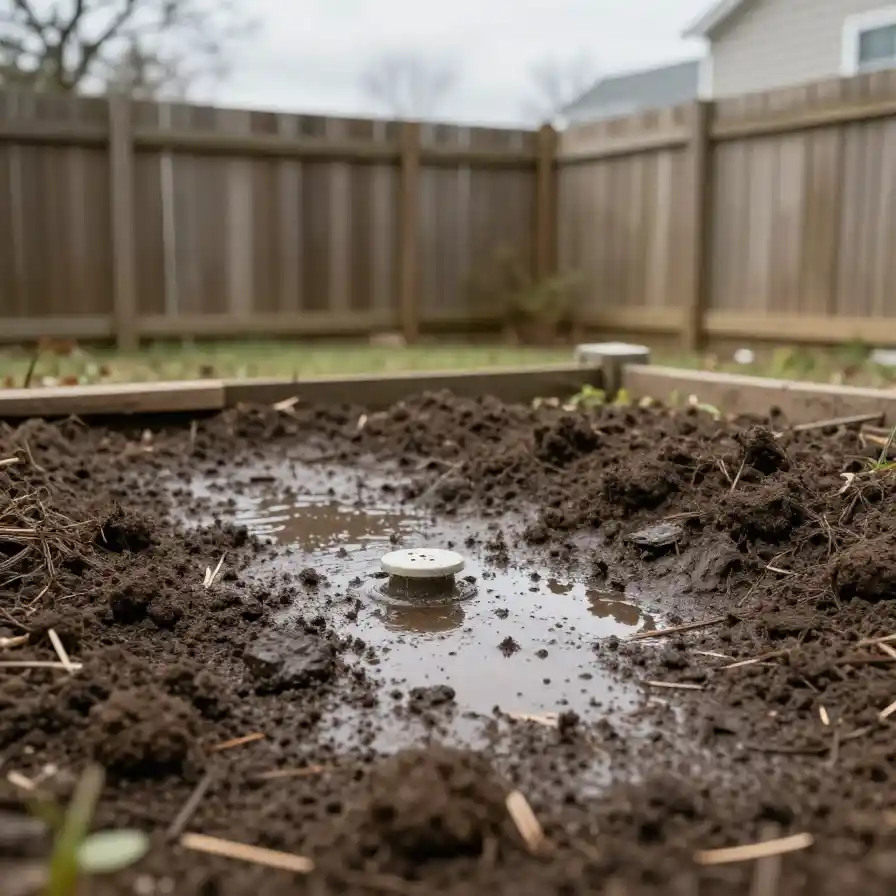
This is the most visible and unmistakable sign of drain field stress. If you notice persistently wet, spongy, or muddy ground in the area where the drain field is located — particularly when it hasn’t rained recently — effluent is surfacing above ground rather than being absorbed into the soil.
This happens when the soil below the trenches is saturated to the point where it can’t accept any more liquid. The effluent essentially overflows upward. In central Kentucky’s clay-heavy soils — common throughout Fayette, Woodford, and Jessamine counties — this can happen faster than it would in sandier soil, because clay absorbs liquid more slowly and holds saturation longer.
Temporarily wet ground after heavy rainfall can look similar. The difference: drain field saturation persists and may worsen over days without additional rain, while normal surface drainage from precipitation typically clears within 24 to 48 hours after the rain stops.
Warning Sign 2: Unusually Lush or Green Grass
A patch of grass that’s noticeably greener, thicker, and healthier than the surrounding lawn — particularly over the drain field area — often indicates effluent is reaching the surface. The nutrients in septic effluent act as fertilizer, which causes that distinctive lush, fast-growing strip of grass.
This is easy to miss or dismiss as natural variation in the lawn. Pay attention if the pattern corresponds to a rectangular or linear area in the yard, particularly if it persists or expands over time. Compare the grass in the suspected drain field area to the grass in parts of the yard clearly away from the septic system.
Warning Sign 3: Sewage Odors Outside
A persistent sewage or sulfur odor in the yard — particularly near the drain field or septic tank — is a sign that effluent is reaching or near the surface. Occasional mild odors can occur normally, especially in warm weather after the system has been heavily used. What you’re watching for is an odor that lingers, intensifies, or appears regularly rather than occasionally and briefly.
Odors near the tank area specifically may indicate a lid that isn’t properly sealed rather than a drain field problem — but either way it warrants a look.
Warning Sign 4: Slow Drains Throughout the House
When every drain in the house is slow — not just one fixture, but toilets, sinks, and tubs across multiple rooms — the problem is usually in the septic system rather than in the household plumbing. A saturated drain field backs effluent up into the tank, which causes the tank’s liquid level to rise, which slows drainage from the house.
System-wide slow drains can also result from an overdue tank that needs pumping. The distinction between a full tank and a failing drain field isn’t always obvious from symptoms alone — which is exactly why a proper assessment matters. Pumping a tank when the real problem is the drain field provides temporary relief but doesn’t solve the underlying issue.
Warning Sign 5: Gurgling Pipes
Gurgling sounds from the toilet or drains — particularly when other fixtures are being used — can indicate the drain system is struggling to handle flow. When a saturated drain field backs effluent into the tank and the tank is close to full, air gets displaced in the pipes as water moves through them, creating a gurgling sound. System-wide gurgling that appears consistently, or that occurs in multiple locations simultaneously, is worth investigating.
Warning Sign 6: Sewage Backup Into the Home
Sewage backing up into the lowest drains in the house — typically a floor drain in the basement, the lowest toilet, or a shower — is a serious sign. At this point, the tank has exceeded capacity and can’t accept new flow from the house. This represents a more advanced stage of system failure and requires immediate attention.
If you’re seeing sewage backup, stop using water in the house as much as possible, and get the system assessed promptly. Continuing normal water use when the system is backed up can cause sewage to reach parts of the home it shouldn’t and may accelerate irreversible damage to the drain field.
Seeing any of these signs at your property?
An early assessment gives you more options. Fill out the form and we’ll get out to evaluate.
Schedule a Drain Field Evaluation
We’ll tell you what’s actually happening.